

I remember the exact moment I realized my body had officially entered a “new season.”
I was in my kitchen, eating the same breakfast I’d had for years — a slice of toast, a bit of fruit, and coffee — when suddenly, halfway through the morning, I felt like someone had unplugged me. My energy dropped, my mood dipped, and I found myself craving sugar like I hadn’t eaten in days.
It wasn’t dramatic, but it was consistent.
And it kept happening.
At first, I blamed stress. Or not sleeping enough. Or Mercury retrograde. Or maybe just “being over 35.” But the truth was much simpler: my old eating style wasn’t supporting my body anymore. I was fueling myself like the woman I used to be — not the woman I was now.
A funny thing happens in your mid-thirties: your body becomes wiser, but also needier. It speaks more clearly. It asks for better support. And it absolutely refuses to run on the same scraps of nutrition it got away with in your twenties.
What I didn’t realize at the time was that so many of the things I was feeling — the fatigue, the cravings, the subtle weight shifts, the slower recovery after workouts, the weird puffiness — were not signs of aging at all.
They were signs that my body needed different building blocks.
More strength. More nourishment. More of the “good stuff.”
And it all came down to what I was putting on my plate.
Turn On Your Body's Fat Burning Power House!
The Quiet Nutritional Shift After 35
No one warns you about this part.
One day you’re fine living on granola bars and iced coffee, and the next your body is like, “No. Absolutely not. We are done with that.”
You start noticing little things — your skin doesn’t bounce back the same way, you’re hungrier but strangely less energized, your muscles feel tighter, your sleep gets lighter, and you suddenly develop a radar-level sensitivity to sugar or alcohol.
The truth is, your body is changing internally long before you see it on the outside.
Collagen begins to decline. Hormones fluctuate. Muscle mass slowly dips. Blood sugar becomes less forgiving. And your digestive system starts preferring whole foods over chaos.
This doesn’t mean something is wrong with you — it means your body is evolving.
And it needs nutrition that supports the woman you are now.
Protein, Collagen & the Foods We Actually Need
If I could go back and talk to my younger self, I would tell her that the biggest gift she could give her future body is eating more protein — not as a diet rule, but as a form of strength and stability.
The moment I began eating adequate protein, everything changed.
My cravings calmed down.
My energy lasted longer.
My muscles recovered faster.
My skin looked smoother.
And I didn’t have that mid-afternoon “crawling through molasses” feeling anymore.
Protein became my steady foundation — not in a boring, dry-chicken-breast way, but in a deeply supportive way that made my meals feel more satisfying and grounding.
And then there’s collagen — the quiet hero of youthful skin, supple joints, strong hair, balanced digestion, and a stable metabolism. We lose a little every year, which explains why many women suddenly feel “older” around their mid-thirties, even if nothing visible has changed.
What I discovered is that collagen isn’t just something you buy in powder form; it’s something you build from the inside out with nutrients like vitamin C, healthy fats, amino acids, and mineral-rich foods. When I shifted my meals to support collagen naturally, my skin and joints thanked me long before any supplement ever could.
Healthy fats also play a bigger role than we realize. They stabilize hormones, slow down the release of sugar into the bloodstream, keep our moods steady, and help us feel full and calm after meals rather than spiking and crashing all day.
They were the missing softness, the missing comfort, the missing nourishment my body had been quietly asking for.
And then there’s fiber — not the glamorous nutrient, but the one that stabilizes digestion, supports hormonal health, helps eliminate excess estrogen, and keeps everything “moving” the way nature intended.
Once I added more fiber-rich foods into my meals, my digestion became lighter and more peaceful, and the bloat I used to fight constantly began to settle down.
What surprised me most was that I didn’t need complicated diets or rigid rules.
I just needed meals with real balance — a foundation of protein, supportive fats, collagen-building foods, and plenty of fiber.
It felt like giving my body a deep exhale.
A Simple, Nourishing Meal to Support Your Mid-30s Body
To make this easy, here’s one of my go-to meals — comforting, fresh, nourishing, and packed with everything your body thrives on as you get older. It’s not “diet food.” It’s grown-woman food. The kind that leaves you feeling full, energized, and mentally clear instead of heavy or sluggish.
Lemon-Garlic Salmon Glow Bowl
This bowl feels like a warm hug and a dose of nutrition all at once.
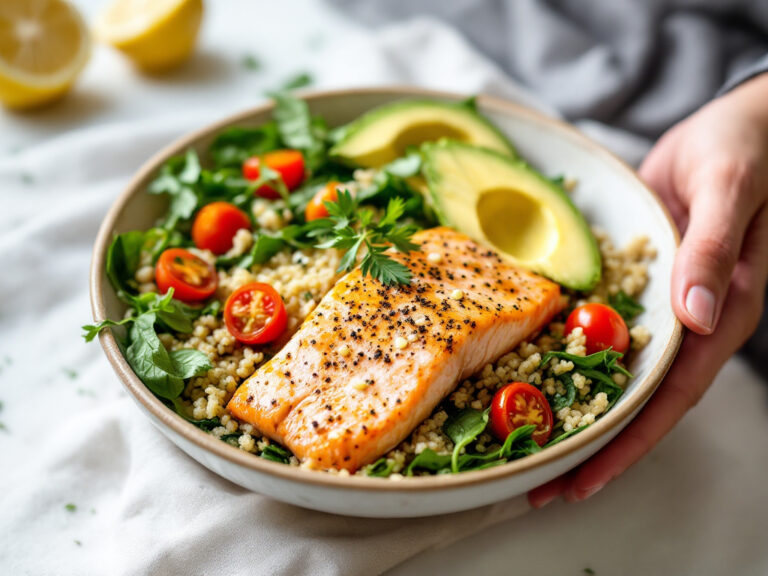
Here’s how to make it:
Start by preparing a small tray with two salmon fillets. Drizzle olive oil over them, add a squeeze of fresh lemon juice, some minced garlic, a sprinkle of sea salt, and black pepper. Bake them at 200°C (about 400°F) for around 12–15 minutes, just until they flake easily with a fork.
While the salmon cooks, prepare a base of fluffy quinoa. The beauty of quinoa is that it’s both comforting and rich in plant-based protein, making it perfect for balancing hormones and supporting steady energy.
Divide the cooked quinoa into two bowls and top each one with a handful of fresh spinach or arugula. Add a few sliced cherry tomatoes for freshness and brightness, plus half an avocado for healthy fats that help keep you full and steady.
When the salmon is ready, place a fillet on top of each bowl. If you’d like, sprinkle pumpkin seeds or sesame seeds over the top for extra minerals and crunch.
What you end up with is a bowl full of everything your body needs now — protein, healthy fats, collagen-building nutrients, fiber, antioxidants, and natural anti-inflammatory compounds. It’s grounding, energizing, and incredibly satisfying.
Your Plate Can Be Your Power
Most women in their mid-thirties don’t need a stricter diet — they need deeper nourishment.
Not less food — better food.
Not restriction — support.
Not calorie counting — balance.
When you choose meals that work with your body rather than against it, you start to feel good again in a way that’s almost shocking.
Your energy smooths out. Your skin glows. Your digestion calms down. Your mood feels more stable. And you begin moving through your day with a sense of lightness instead of overwhelm.
You deserve that.
You deserve to feel nourished, supported, and deeply connected to your body.
You deserve meals that give you strength, beauty, and stability from the inside out.
Your plate is not just fuel — it’s information.
And when that information is aligned with who you are now, everything begins to shift in the right direction.