
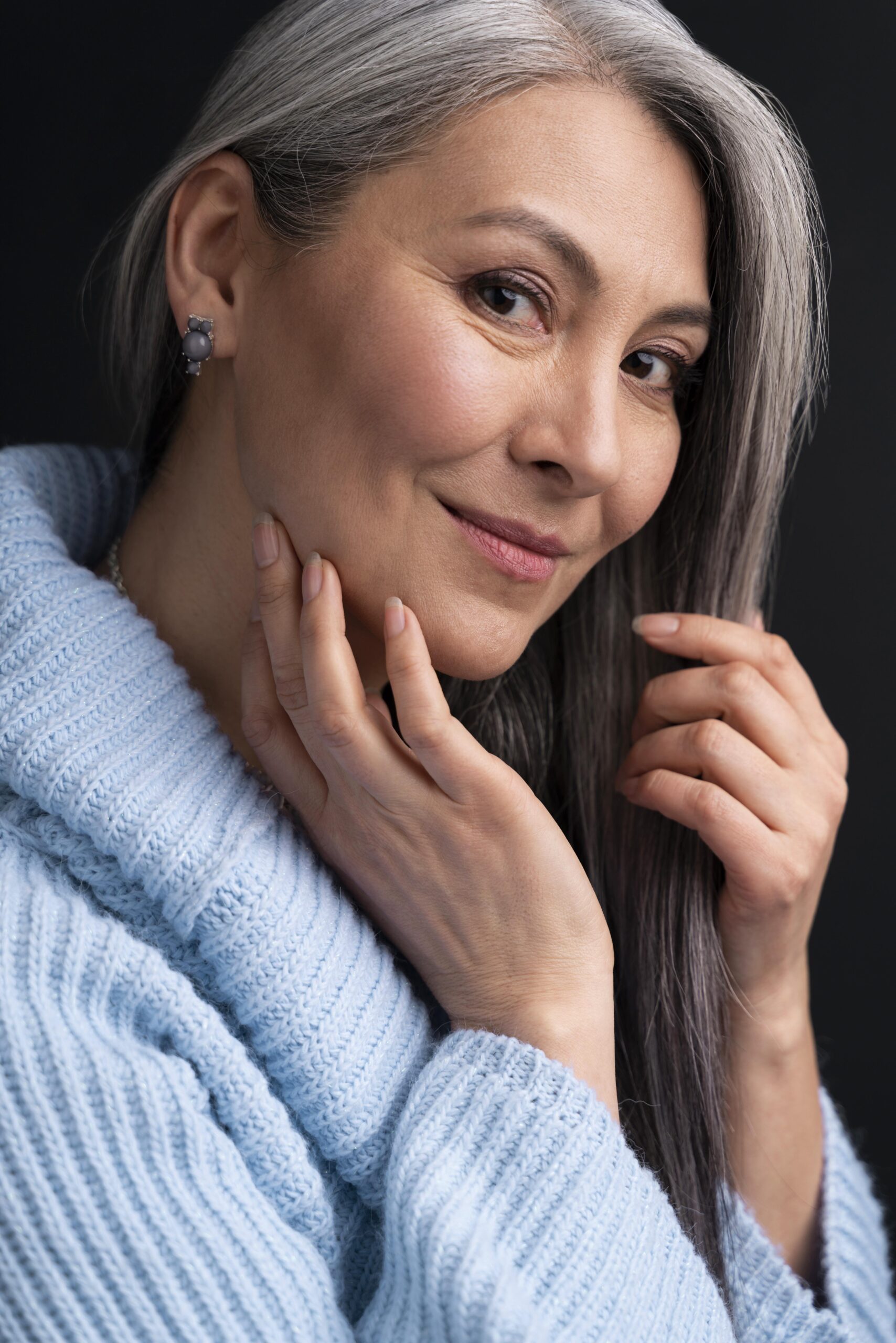
For a long time, I told myself I was imagining things.
The dullness.
The way my skin no longer reflected how alive and energetic I still felt inside.
The fine lines that seemed to appear overnight after a stressful few weeks.
I drank more water. I upgraded my skincare. I rotated serums like a scientist running experiments. I even changed my pillowcases twice a week, convinced that this would finally be the thing that brought my glow back.
And yet, every time I caught my reflection, I had the same thought so many women quietly carry: Why does my skin look older than I feel?
If that question has ever crossed your mind, you’re not alone. A growing number of women are asking it too—and for the first time, science is offering an answer that actually makes sense.
The Moment Everything Clicked
The realization came unexpectedly, while watching a short clip of a dermatologist explaining why some women seem to age faster than others—especially around perimenopause and menopause.
She said something that stopped me cold: “It’s not the creams, and it’s not the years. It’s the signals your skin stopped hearing.”
At first, I brushed it off. Another dramatic soundbite, I thought. But then she went deeper, describing changes that felt uncomfortably familiar.
Skin that looks dull even though you exfoliate.
Makeup that no longer sits the way it used to.
That slow disappearance of glow you can’t quite pinpoint when it happened.
The way stress suddenly shows up on your face instantly, with no buffer.
It felt like she was describing me. And for the first time, I didn’t feel like my skin was failing me. I felt like it was trying to communicate something I hadn’t understood yet.
What’s Really Happening to Skin During Menopause
Menopause doesn’t just affect hormones—it affects communication. Inside your body, estrogen plays a critical role in skin thickness, hydration, collagen production, and cell turnover. As estrogen fluctuates and declines, the skin’s renewal cycle naturally slows.
That 28-day renewal rhythm you may have heard about? For many women after 35, and especially during menopause, it stretches longer and longer. Dead skin cells hang on too long. New cells take more time to surface. Collagen production declines. Hydration drops.
But here’s the part no one talks about enough: these changes don’t happen in isolation.
Your skin doesn’t age alone. It ages as part of a system.
And that system includes your gut.
The Gut–Skin Connection No One Explained to Us
For years, skincare focused almost exclusively on the surface. Cleanse. Exfoliate. Treat. Moisturize. Protect.
But emerging research points deeper—to the gut-skin axis. Your gut microbiome doesn’t just help digest food; it plays a key role in nutrient absorption, inflammation control, and the production of compounds that signal skin cells to renew properly.
When gut bacteria fall out of balance, those signals weaken.
Skin cells stop receiving the messages they need to regenerate efficiently. Collagen synthesis slows. Hydration drops. Pigmentation becomes more uneven. The glow fades—not because you’re doing something wrong, but because the communication loop has been disrupted.
That’s why so many women do everything “right” and still feel like their skin is aging faster than it should.
It’s not discipline.
It’s not laziness.
It’s biology.
“I Thought I Was Just Getting Older…”
That was something one woman said in the video I watched. She described trying everything—retinol, lasers, peels, supplements—only to feel increasingly frustrated.
What changed was learning that her gut bacteria were functioning older than the rest of her body. Her skin wasn’t broken; it was under-informed.
Once she supported her body in a way that restored those internal signals, her skin’s renewal rhythm slowly restarted. Friends began asking what foundation she was using.
She wasn’t.
Her skin simply looked awake again.
That’s when something shifted for me. Maybe my skin wasn’t betraying me. Maybe it was just waiting for a different kind of support.
Why Expensive Creams Eventually Stop Working
Here’s the hard truth: most skincare products treat symptoms, not causes.
They smooth. They hydrate temporarily. They polish the surface. But if the deeper renewal process is sluggish, those results fade quickly.
It’s like repainting a wall with a cracked foundation. The surface might look better for a while, but the structure underneath hasn’t changed.
Research now shows that when certain gut-derived compounds are missing, skin cells take longer to regenerate. That means no amount of exfoliation can force true renewal if the internal signals aren’t there.
This explains why so many women feel like their skincare “stopped working” in midlife. It didn’t stop working. It simply reached the limits of what surface care alone can do.
The Blue-Root Discovery That Changed the Conversation
In a fascinating study, researchers identified a blue-rooted botanical containing a compound that behaves similarly to retinol—but without the irritation, dryness, or inflammation.
What made it truly interesting wasn’t just its effect on the skin, but its role in supporting the gut microbiome and the enzymes involved in skin renewal.
By helping restore communication between the gut and the skin, this compound allowed the body to restart its own natural renewal rhythm. Not aggressively. Not forcefully. But intelligently.
Women using approaches based on this research reported smoother texture, refined pores, improved hydration, and something harder to measure but instantly recognizable—their glow returning.
Not because they looked younger, but because they looked more like themselves again.
If Any of This Sounds Familiar…
What struck me most about this research wasn’t the promise of looking younger. It was the permission to stop fighting my body.
Menopause isn’t a breakdown. It’s a transition. And skin changes during this time aren’t something to hide—they’re something to understand.
When you support renewal from within, the changes aren’t just visible. They’re emotional. Confidence returns. Ease returns. You recognize yourself again.
That’s what makes this discovery so powerful. It’s not about erasing age. It’s about restoring vitality.
One Last Thought
Every woman deserves to feel at home in her own skin.
If your reflection hasn’t been matching how young, curious, and alive you still feel inside, there is nothing wrong with you. And there is nothing “wrong” with your skin.
The science is evolving. And what it’s showing us is something quietly hopeful: aging doesn’t have to mean dullness, dryness, or disconnection.
Sometimes, it simply means your body is asking for a new kind of conversation.
And when that conversation restarts, the glow you thought was gone forever often finds its way back—naturally, gently, and on your own terms.